🆕 2025–2026: Three landmark papers on tungsten carbide catalysis — ACS Catalysis, JACS & EES Catalysis. Read more →
Department of Chemical & Sustainability Engineering · University of Rochester

Catalysis for a Sustainable Future

The Porosoff Group develops next-generation catalysts to transform C1 and C2 resources — CO₂, CO, CH₄, C₂H₆ — into plastics, chemicals, and fuels. We combine precision synthesis, in situ characterization, Joule heating, and AI-driven discovery.

20+
Peer-Reviewed Papers
6,037
Total Citations
2026
Latest Publication
DRAWING NO. PRG-RWGS-001 SCALE 1:NTS UNIV. OF ROCHESTER CO₂ CO₂ feed H₂ H₂ feed FCV-01 FCV-02 MIX + PRE-HT ~200°C FURNACE CATALYST BED β-W₂C / Mo₂C T = 600–800°C T COND. GC DETECTOR CO C₂–C₄ PRODUCTS VENT REACTOR TUBE RWGS REACTION: CO₂ + H₂ ⇌ CO + H₂O ΔH = +41 kJ/mol (endothermic) F-T SYNTHESIS: nCO + 2nH₂ → CₙH₂ₙ light olefins (C₂–C₄) β-W₂C phase ctrl. REV A — POROSOFF RESEARCH GROUP, DEPT. OF CHEMICAL & SUSTAINABILITY ENGINEERING, UNIVERSITY OF ROCHESTER
Research Areas

Four Frontiers of Catalytic Science

Understanding the relationships between chemical reactivity and catalyst properties — using controlled synthesis, in situ techniques, pulsed Joule heating, and AI-guided discovery.
01

CO₂ Hydrogenation to Plastics, Chemicals & Fuels

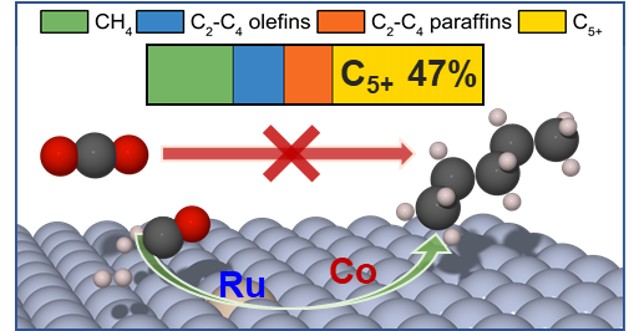
Novel dual-functional catalysts to selectively produce hydrocarbons from CO₂ via RWGS and Fischer-Tropsch synthesis. Recent work establishes β-W₂C as a phase-selective, high-performance RWGS catalyst rivaling platinum at a fraction of the cost.

RWGS · FT · Tungsten Carbide
02

Pulsed Joule Heating for Catalyst Synthesis & Electrification

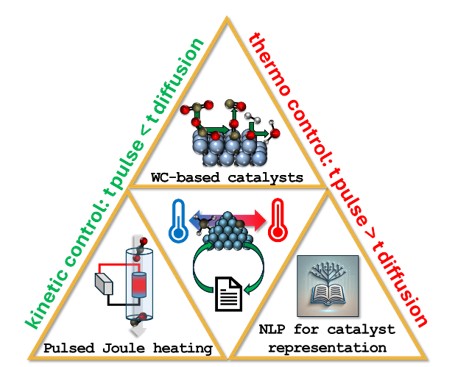
We exploit the ultra-rapid heating rates of Joule reactors to access previously inaccessible catalyst phases — including entropically favorable WC phases — and to electrify high-temperature catalytic processes for compatibility with intermittent renewable energy sources.

Joule Heating · Phase Control · Electrification
03

AI & Natural Language Processing for Catalyst Discovery

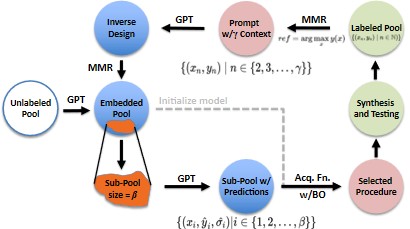
We represent catalysts using the text of synthesis procedures and reaction conditions, combining NLP with Bayesian optimization to accelerate discovery of earth-abundant active catalysts — without expensive structural characterization. Funded by NSF CAREER Award #2345734.

NLP · LLMs · Bayesian Optimization
04

Thermal Coupling & Localized Temperature Measurement

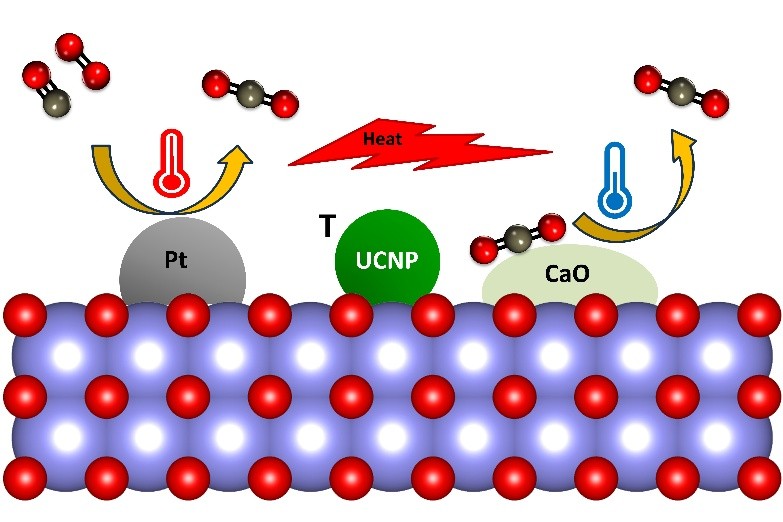
We use upconverting nanoparticle-based luminescence thermometry to directly measure catalyst surface temperatures in situ, revealing thermal gradients of 10–100°C relative to bulk readings. This enables precise coupling of exothermic and endothermic tandem reactions for improved energy efficiency.

Luminescence Thermometry · Tandem Catalysis · DFMs
Explore Our Research →